How to Bore Sight a Rifle: 6 Easy Steps Before Zeroing
To bore sight a rifle, you line up the barrel with your scope so both point at the same spot on a target. You do it before you fire a shot, usually by looking down the open bore or by using a laser tool, then adjusting the scope until the crosshairs match.
Bore sighting does not give you a finished zero. It gets your point of aim close enough that your first rounds hit the paper at 25 yards instead of somewhere in the berm.
That saves ammo, time and frustration, especially after you mount a new scope. It takes about ten minutes and needs very little gear.
This guide covers the no-tools method, the laser bore sighter method, and what to do right after. Keep reading and you will be ready for the range.
Key Takeaways
- Bore sighting is a rough pre-alignment of barrel and scope. It is not a substitute for live-fire zeroing.
- If you can remove the bolt (or open the action) and see through the barrel, you can bore sight with no special tools.
- A laser bore sighter works for rifles you cannot see through, such as many lever-action and some semi-auto designs.
- A rock-steady rest matters more than anything else. If the rifle moves between checks, the result is useless.
- Always unload and verify the rifle is clear first, and follow bore sighting with test shots at 25 yards before moving to 100.
Choose a Bore Sighting Method and Clear the Rifle
Pick your method first, then make the rifle safe. Treat every rifle as loaded, even when you think it is empty. Remove the magazine, open the action, and visually and physically check that the chamber and magazine well are empty. Keep all ammunition out of the room while you work.
Keep the muzzle pointed in a safe direction and your finger off the trigger throughout, even though the bolt is out.
Quick comparison of methods
| Method | Tools needed | Works best on | Main drawback |
|---|---|---|---|
| Visual (look down the bore) | Rest or vise, target | Bolt-action rifles and AR-style rifles with the bolt removed | Needs a clear line of sight through the barrel |
| Laser bore sighter | Chamber or muzzle laser | Lever-action, some semi-autos, any rifle you cannot see through | Cheap lasers can be slightly off; dot is harder to see in bright light |
| Collimator or grid tool | Muzzle-mounted collimator | Anyone who wants a precise indoor alignment | Costs more and is less common |
| Mechanical center of scope | None | Fallback when nothing else works | Least accurate starting point |
For most shooters, the visual method or a chamber laser is all you need.
Set Up the Rifle on a Stable Rest
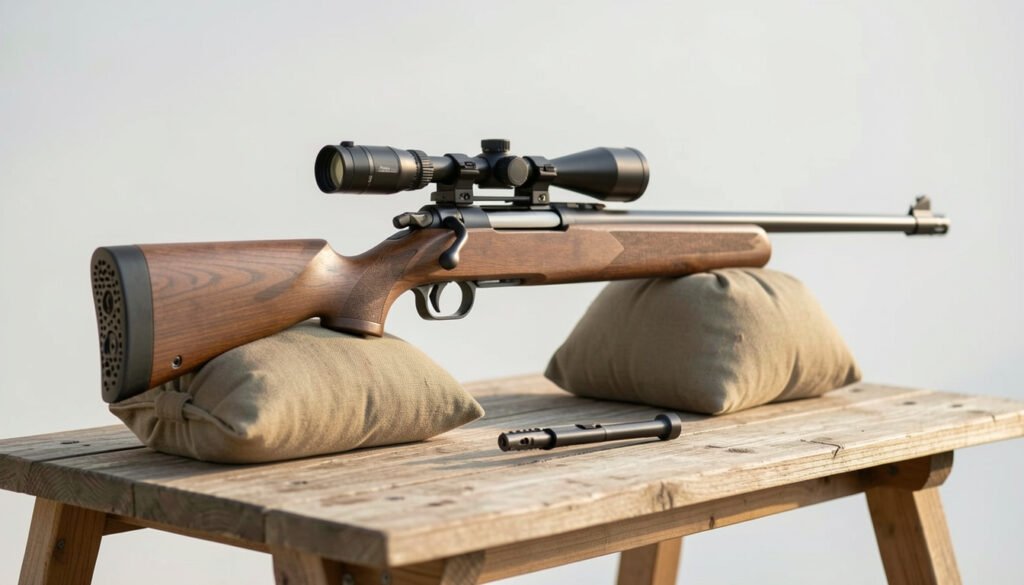
The rifle must not move while you check the bore and adjust the scope. A gun vise is ideal. Sandbags, a front rest with a rear bag, or a bipod on a bench also work well.
Before you start, make sure the scope is mounted correctly. Set proper eye relief, tighten the rings evenly, and make sure the reticle is level with the rifle. A canted scope will throw off every adjustment you make later.
- Level the rifle as well as you can from side to side.
- Check that nothing is touching the barrel or scope that could shift.
- Set the rifle where you can reach the turrets without touching the rest.
Pro tip: Mark the rest or place a piece of tape under the stock so you can see right away if the rifle has shifted.
Place a Target at 25 Yards
A distance of about 25 yards is the standard starting point for bore sighting. It is close enough to see easily and far enough that small errors do not matter much. If you are indoors, a well-lit hallway and a clear reference point, like a light switch, can work, though a longer distance is more accurate.
Use a target with a clear, high-contrast center. A bright orange circle roughly 3 to 6 inches wide on your normal paper target is easy to see through the bore. Make sure there is a safe backstop behind it, and never point the rifle at anything you are not prepared to hit.
Whatever you choose, use the same target for both the bore view and the scope view.
Bore Sight the Rifle by Lining Up the Bore
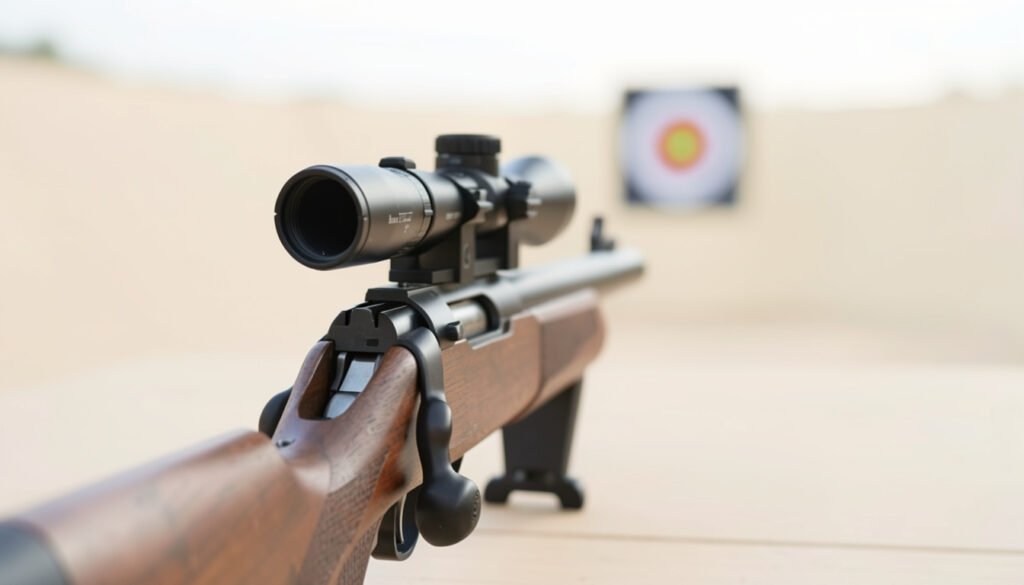
This is the heart of the process. The steps differ slightly depending on the rifle.
Bolt-action rifles
Remove the bolt, then look through the rear of the action, down the barrel. Move the rifle on the rest until the target’s center sits in the middle of the circle of light you see through the bore. Keep it there. If the rifle has a very short or odd action, check your owner’s manual for the correct bolt removal procedure.
AR-style rifles
Separate the upper receiver from the lower, then remove the bolt carrier group. That opens a clear line of sight through the barrel. Secure the upper in a rest or vise and center the target in the bore just as you would on a bolt gun. If you are unsure how to disassemble your rifle, use the manual rather than guessing.
Rifles you cannot see through
Lever-actions and some other designs do not give you a clean view down the bore. Use a laser bore sighter instead. Some look like a cartridge and sit in the chamber, while others fit in the muzzle. Switch it on and point the laser at your target, again in a safe direction.
- Follow the maker’s instructions for your specific laser.
- If you use a muzzle-mounted tool, remove it before you load or fire. This is essential.
- Bright daylight can wash out the dot, so work in shade or at a shorter distance if needed.
Adjust the Scope to Match the Bore
With the bore (or laser) still centered on the target, look through the scope. Without touching the rifle, turn the windage turret for left and right, and the elevation turret for up and down, until the crosshairs sit on the same point you saw through the bore.
Make small, steady adjustments and keep checking. Glance back through the bore every so often to confirm the rifle has not moved. If it has, re-center and start again. With a laser, simply move the reticle until it sits on the dot.
Use gentle hands on the turrets. If the reticle will not reach the target, the scope may be mounted poorly, or you may need shims or different rings. That is a mounting issue, not a bore sighting problem, and a qualified gunsmith can sort it out.
Fire Test Shots to Confirm Your Zero
Now put the rifle back together, reload it only when you are at the range, and fire a few shots at the 25-yard target. A bore-sighted rifle should land on the paper, though not necessarily in the bullseye. As one common guide puts it, this process is only an estimate, so you always need live rounds to confirm.
Adjust the scope based on where the group lands, then move back to your final distance. Our related guides explain how to sight in a rifle for a 100-yard zero and how to sight in a rifle scope in more detail.
Good shooting position helps too. If you are new to bench or field shooting, read how to hold a rifle correctly so your groups are tight enough to trust.
Common mistakes to avoid
- Letting the rifle shift while adjusting the turrets.
- Skipping a safety check because the bolt is out.
- Stopping at bore sighting and heading to a hunt without live-fire confirmation.
- Forgetting to remove a muzzle laser or tool before firing.
Frequently Asked Questions
Is bore sighting the same as sighting in?
No. Bore sighting is a rough alignment done before you fire, while sighting in (zeroing) uses live rounds to match your point of impact to your point of aim. Bore sighting just gets you close so zeroing is faster.
How far should I bore sight a rifle?
About 25 yards is the usual starting distance. Some shooters go out to 50 yards if they have a clear view, but shorter distances are easier to see and are fine for a first pass.
Can I bore sight a rifle without removing the bolt?
Yes, with a laser bore sighter or collimator, which sits in the chamber or muzzle. This is the usual route for lever-actions and rifles where you cannot see through the barrel.
Do I need to bore sight again after changing ammunition?
Usually not. Bore sighting depends on the barrel and scope alignment, not the load. You will, however, need to re-check your zero with live rounds if you change ammunition, because different loads hit at different points.
Conclusion
Learning how to bore sight a rifle is one of the quickest ways to make a range trip productive. Clear the rifle, steady it on a good rest, center the bore on a target at 25 yards, and match the scope to it. A laser tool covers rifles you cannot see through.
Remember that bore sighting is only the first step. Confirm with live rounds, then fine-tune at your final distance. Check local rules and range policies if you are unsure where you can shoot.
Take your time, stay safe, and you will have your rifle on paper in just a few shots.