Is an AR-15 an Assault Rifle? Definitions and Legal Facts
By the technical definition, a civilian AR-15 is not an assault rifle. It is a semi-automatic rifle, which means it fires one round each time you pull the trigger.
The confusion is understandable. The AR-15 looks a lot like the military M16, and the media and politicians often use “assault rifle” and “assault weapon” as if they meant the same thing. They don’t.
The letters “AR” come from ArmaLite Rifle, the company that originally designed the platform in the 1950s. They have nothing to do with the words “assault rifle.”
This guide covers what an assault rifle really is, how the AR-15 differs, where the original rifle came from, and why the legal term assault weapon muddies the water.
Keep reading and you will be able to explain the difference clearly to anyone who asks.
Key Takeaways
- A true assault rifle is a select-fire rifle that can fire automatically or in bursts. A civilian AR-15 is semi-automatic only.
- “AR” stands for ArmaLite Rifle, the company that designed the original rifle. It does not mean “assault rifle” or “automatic rifle.”
- “Assault weapon” is a legal and political term. Its definition changes from one jurisdiction to another and is based mostly on features, not on how the gun fires.
- Fully automatic firearms are heavily restricted under federal law, and converting a semi-auto to automatic fire is illegal for nearly everyone.
- Laws on AR-style rifles differ widely by location, so always check current rules with official sources before you buy, build or travel.
Is an AR-15 an Assault Rifle? The Short Answer
No. A civilian AR-15 does not meet the standard definition of an assault rifle, mainly because it lacks selective fire. Despite its military-style appearance, the civilian AR-15 does not meet the criteria to be considered a true assault rifle, primarily due to its semi-automatic operation that fires only one round per trigger pull.
That is the technical answer. The practical answer is that people use the term loosely, and you will hear it in news stories, debates and legislation. Knowing the exact meaning helps you follow what is actually being claimed.
Under federal law, a gun that fires one round per trigger pull is classed as a semi-automatic firearm. It is not an automatic or assault weapon under federal law. Machine guns have their own tightly regulated category.

What Makes a Rifle a True Assault Rifle
The term “assault rifle” comes from the military. It describes a specific type of weapon, and most definitions list the same core traits.
The Three Core Traits
- Selective fire: The shooter can switch between semi-automatic and fully automatic or burst fire.
- Intermediate cartridge: It fires a round that is smaller than a full-power battle rifle round but stronger than a pistol round.
- Detachable magazine: It feeds from a removable box magazine.
The first trait is the one that matters most here. The AR-15 is a gas-powered semiautomatic rifle, meaning one pull of the trigger corresponds to only one round being fired. Without a selector for automatic or burst fire, it falls outside the definition.
The AR-15 does share the other two traits with many assault rifles. It uses a detachable magazine and commonly fires an intermediate cartridge. It is most commonly chambered in .223 Remington or 5.56×45mm NATO. Those features alone do not make a rifle an assault rifle.
How an AR-15 Differs From Military Rifles
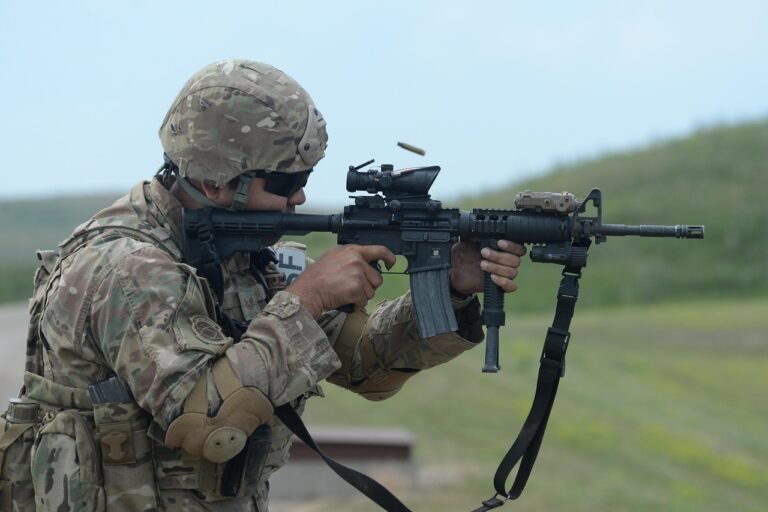
Side by side, a civilian AR-15 and a military M16 or M4 can look nearly identical. Inside, the fire control parts are different. The table below shows the key differences.
| Feature | Civilian AR-15 | Military assault rifle (e.g., M16) |
|---|---|---|
| Fire modes | Semi-automatic only | Semi-auto plus burst or full-auto |
| Trigger pull result | One round per pull | One round, a burst, or continuous fire |
| Typical cartridge | .223 Rem or 5.56 NATO | 5.56 NATO |
| Magazine | Detachable | Detachable |
| Civilian ownership | Legal in many places, restricted in others | Tightly regulated under federal law |
Some people claim an AR-15 can fire hundreds of rounds per minute. In practice, a semi-automatic rifle fires only as fast as the shooter can pull the trigger.
Pro tip: When you hear a debate about “assault rifles,” ask which definition the speaker is using, because the technical and political meanings are not the same.
Where the AR-15 Came From
The history explains why the name and the look cause so much confusion. ArmaLite designed the original AR-15 in 1956, based on its AR-10 rifle, as a lightweight rifle for a new high-velocity, small-caliber cartridge so infantrymen could carry more ammunition.
The early military version was select-fire. That is why some reference works, including Wikipedia, describe that original ArmaLite AR-15 as an assault rifle. It is a fair point and worth knowing, but it does not describe the rifles sold to civilians today.
In 1959, ArmaLite sold its rights to the AR-15 to Colt, and Colt continued to use the trademark for its semi-automatic-only rifles marketed to civilian and law-enforcement customers. The military adopted its own select-fire version as the M16.
Today, “AR-15” works more as a style than a single model. An AR-15 is not a specific model, but a style. Many manufacturers make rifles built on the same basic design. Some in the industry call them modern sporting rifles.
Assault Rifle vs. Assault Weapon: Why the Terms Get Mixed Up
This is the real source of the debate. “Assault rifle” is a technical military category. “Assault weapon” is a label that lawmakers created, and it has no single fixed meaning.
What “Assault Weapon” Usually Means in Law
Laws that use this term generally define it by a list of features rather than by how the gun fires. A rifle may be covered if it has a detachable magazine plus one or more features such as a pistol grip, a folding or telescoping stock, or a flash suppressor. Some laws also name specific models.
Because the definitions are written by different legislatures, the same rifle can be an “assault weapon” in one place and an ordinary rifle in another. While technically incorrect to label it an “assault rifle,” many jurisdictions have legally classified AR-15 style firearms as “assault weapons,” leading to bans and restrictions.
Why It Matters to You
If you own or plan to buy an AR-style rifle, the legal label matters more than the technical one. Magazine limits, feature restrictions, registration rules and outright bans can all apply depending on where you live or travel. Rules also change as new laws pass and courts rule on them.
- Check your state and local laws before you buy.
- Check the rules again before you travel with a rifle.
- Use official sources such as the ATF, your state agency, or local law enforcement. For a complex situation, talk to a qualified attorney.
Can an AR-15 Be Made Fully Automatic?
No lawful path exists for ordinary owners to do this. Mechanically, the AR platform is adaptable, but turning a semi-automatic rifle into an automatic one is a serious federal crime for almost everyone. Do not attempt it, and avoid any product or “kit” that claims to do it.
Machine guns are regulated under the National Firearms Act and related federal law. In general, civilians can only own certain machine guns that were registered before a federal cutoff date, and the transfer process is strict. If you are curious about the details, the ATF is the right place to read the current rules.
Keep these points in mind:
- A stock civilian AR-15 is semi-automatic and legal in most places, subject to local law.
- Parts that change how the trigger or fire control works can create serious legal trouble.
- Any work on the fire control group beyond basic maintenance should go to a qualified gunsmith, and only for lawful, factory-specification work.
Safe Handling and Where an AR-Style Rifle Fits
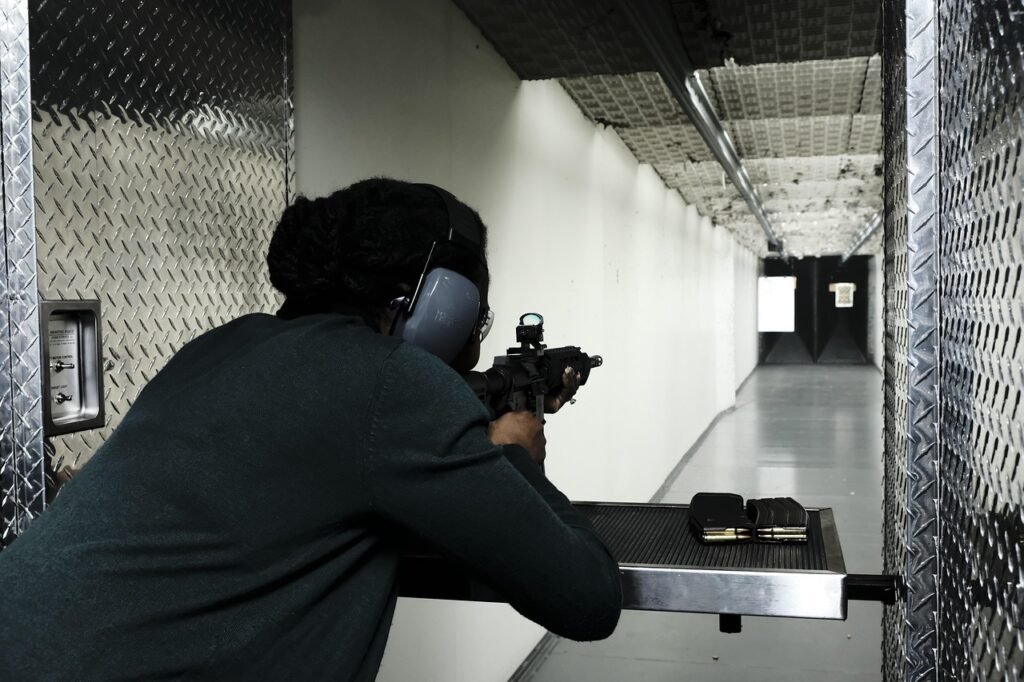
People use AR-style rifles for target shooting, varmint control, competition, home defense and, where the law allows, hunting. Many shooters like them because they are modular, light and easy to adjust. Their shorter versions overlap with carbine rifles, so it helps to know how those terms differ.
No matter what you call a rifle, the same safety rules apply every time you handle it:
- Treat every gun as if it is loaded.
- Keep the muzzle pointed in a safe direction.
- Keep your finger off the trigger until you are ready to fire.
- Unload and verify the chamber is empty before cleaning or maintenance.
New shooters should also learn a stable stance and grip. Our guide on how to hold a rifle correctly is a good place to start.
Frequently Asked Questions
What does AR stand for in AR-15?
AR stands for ArmaLite Rifle. It is named after the company that developed the original AR-10 and AR-15 models, and it refers to the manufacturer, not the rifle’s function.
Is an AR-15 a machine gun?
No. A standard civilian AR-15 fires one round per trigger pull. A machine gun fires continuously while the trigger is held, and those are heavily regulated under federal law.
What is the difference between an AR-15 and an M16?
The two look alike, but the M16 is a military rifle with select-fire capability. The civilian AR-15 is semi-automatic only. The internal fire control parts are what set them apart.
Are AR-15s legal to own?
In many places they are legal, but rules vary. Some jurisdictions restrict or ban rifles classed as “assault weapons,” and laws change over time. Confirm the current rules where you live with official sources or an attorney before you buy.
Conclusion
So, is an AR-15 an assault rifle? Not by the technical definition. A civilian AR-15 is a semi-automatic rifle with no selective-fire capability, and “AR” refers to ArmaLite, not to assault rifles.
The debate continues because “assault weapon” is a separate, changeable legal term, and the AR-15 looks like its military cousins. Once you know the difference, you can read news stories and laws with a clearer eye.
If you own, or plan to own, an AR-style rifle, learn your local rules, follow the four safety rules every time, and stay informed. That is the best way to be a responsible and confident gun owner.